23 July 2026
The part that turns this from a Netflix story into a category one.On 23 July, Amazon put Luna — its streaming game service, which runs the game on a distant computer and sends back the picture — inside the Prime Video app for Fire TV users in the US and UK. Until July, Luna lived in its own app, a polite way of saying nobody found it.
 Amazon · Luna in Prime Video
 Microsoft · Free ad-supported streaming
Two companies, one afternoon, no coordination, adjacent conclusions sharing a surface. Once you see it as a layer the household already pays for, the Netflix closures stop looking like a retreat and start looking like the most coherent thing anyone in this space has done. If you are Netflix, you do not need a studio to fill a tab.
What the Numbers Actually Say
The stale statistic everyone still cites, and the one Netflix just gave up.Every piece written about Netflix games for four years has cited the same statistic, and it is now stale enough to be misleading: fewer than 1% of Netflix subscribers play its games. That figure comes from Apptopia estimates of 1.7 to 2.2 million monthly players against a subscriber base of 221 million, and it describes 2022 and 2023, when Netflix games meant downloading a mobile app from a separate store and remembering it existed.
| Disclosure | What Netflix said | Confidence |
|---|---|---|
 Playground Playground | Children's games app launched April; tripled daily active players in three months; kids' mobile games engagement up 600% year on year | High |
 Cloud games Cloud games | Monthly active players up elevenfold since October 2025, adoption significantly ahead of the mobile curve, higher retention | High |
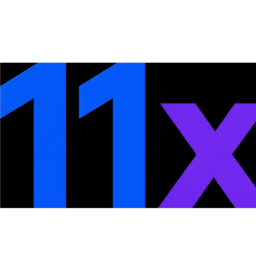 Base for the 11x Base for the 11x | Never published | Provisional |
 Gameplay hours Gameplay hours | Asked directly on the July call. Declined | High |
 Games spend Games spend | Described by Peters as very small relative to overall content spend | High |
Read the growth rate alongside the closures. The delivery model that runs on a television is outperforming the one that ran through an app store, on both adoption and retention, and Netflix responded by shutting the studios that were building for the app store model.
Nobody Agrees What This Market Is Worth
Nine research firms, nine numbers, the same year.Before taking the elevenfold growth claim any further, it is worth sitting with how unstable the underlying category is. Ask nine market research firms how big the global cloud gaming market is in 2026 and the answers span nearly six times, from $4.81 billion to $28.29 billion. Every one of those firms is describing the same twelve months.
Estimates as published by each firm for calendar 2026. Forecast CAGRs, over different end years, range from 21.0% to 50.2% — the disagreement about growth is as wide as the disagreement about size. Colour assignment between narrow and broad scope is the author's reading of each firm's stated methodology, not a label the firms use. Likely
The gap is not measurement error. It is a scope disagreement dressed up as a forecast. The narrow definition counts only pure streaming-infrastructure revenue — the pipes. The broad definition folds in subscription bundling, ecosystem advertising, and platform revenue attributable to games delivered this way, which is closer to what this report has been calling programming revenue. Statista's user-count data is comparatively stable and worth anchoring to instead: 482.3 million global cloud gaming users in 2026, up from 395.9 million in 2024, roughly 6.1% of internet users worldwide, and under 5% of the total games market by any measure. High Statista user counts
The Top 10 Is the Tell
A card game beat a service's own owned IP.Netflix awards a Top 10 badge for global playtime inside its games catalogue, updated daily. It covers mobile titles only, and it pointedly excludes the TV and web games the rest of this report is about. A Top 10 is not a sales chart. It is a scheduling device Netflix invented for television and has now bolted onto games, which tells you which of the two things games are being managed as.
| Rank | Title | Note |
|---|---|---|
| 1 |  Solitaire Solitaire | A card game, topping a service with over a hundred titles |
| 2 |  GTA: San Andreas GTA: San Andreas | Netflix's most-installed title ever, about 57M installs — removed December 2025 |
| 3 |  Football Manager Mobile Football Manager Mobile | — |
| 4 |  Bloons TD 6 Bloons TD 6 | — |
| 5 |  Squid Game: Unleashed Squid Game: Unleashed | Made by Boss Fight, since closed |
Compiled across a three-month window in summer 2025 and verified by Variety. Netflix declined to comment on the compiled rankings, and nobody has re-run the numbers since. High Variety · three-month window
Look at what happened to the game in second place. San Andreas was not only the runner-up on playtime, it was the most-installed title the service had ever carried. In December 2025, Netflix removed it. You do not drop your most-installed game because it is failing. You drop it because it is the wrong shape: a licensed, twenty-year-old open-world epic, downloaded to a phone, played for hours by people who already knew what it was. It is a product. Everything Netflix has kept is a slot.
Built to Be Interrupted
The design constraint is the train tunnel, not the download.We keep calling this cloud gaming, which describes the plumbing and misses the point. The point is not where the game runs. It is that games are being reclassified from products into programming: put in front of you rather than sought out, not owned, measured in time occupied rather than copies sold, and advertising-viable in a way products largely are not.
The usual framing says games need to be broken into smaller pieces so they travel better. That is a download problem, and streaming does not have one, because nothing arrives on the device. The real problem is what survives a dropped connection, and how fast it comes back. Answered properly, that produces a specific set of constraints: loops short enough that losing one is annoying rather than devastating, state held server-side rather than in the session, resume in seconds rather than a loading screen, and no punishment for a drop the player did not cause.
Every category Netflix kept — a thirty-minute horror game, a daily trivia refresh, round-based party games, children's games built to be abandoned mid-round — is interruption tolerant. That was a session-length decision wearing a content decision's clothes.
Amazon's own sentence names the audience this serves: billions play, a few hundred million own the hardware. That gap has sat unserved because the industry's distribution machinery was built around people who buy boxes. Programming is how you serve it — a tab in an app the household already pays for, an advert before an hour of play, on a television that was already in the room. Gen Alpha reaches spending age around 2027. They will not experience this as a change. They will experience it as what games are.